

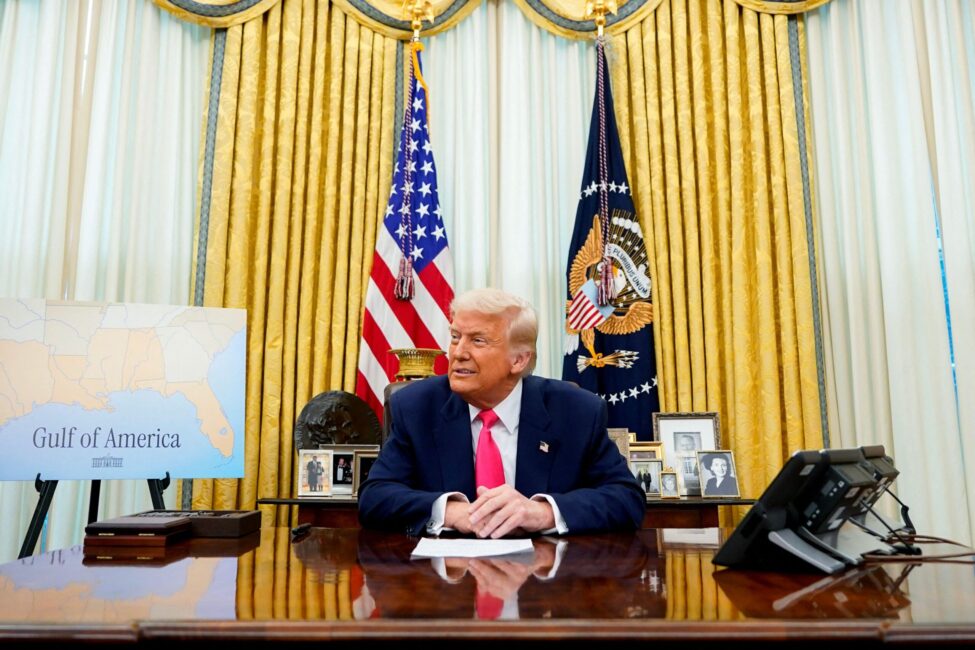
Op-ed by Summer Lane | Photo: Alamy
It’s hard to believe, but in the late 1800s, the United States found itself in the midst of a massive financial surplus that led to an era of industrial growth and expansion, and while the system was certainly far from perfect, this wealth is a testament to both the power of tariffs and the detrimental effect of burdensome taxation.

Throughout the 1880s, the U.S. Treasury began to take in around $100 million more than it was spending every year, according to American Heritage. The United States economy was growing so quickly that the government couldn’t keep up with it, and the stockpile of wealth in the Treasury essentially became a problem, because that money wasn’t circulating freely, therefore creating an unnecessarily finite money supply that could lower laborers’ wages and slow down economic growth.
What caused this robust swell in American wealth – a swell so massive that money was being stockpiled in the U.S Treasury?

How is it possible that the United States became so rich in the wake of a devastating, bloody Civil War just a few decades prior?
Arguably, this wealth came from tariffs charged on imported goods into the United States. American Heritage described it like this: “It alone accounted for some 50 to 60 percent of total federal revenue. And it was almost politically impossible to cut it.”
The tariff system had stiff critics and political opposition, but for better or for worse, it clearly contributed to a massive chunk of domestic wealth in the American economy – a Gilded Age that the country has never experienced in that way again.
The rapid intake of revenue during this time is fascinating, especially as President Trump is poised to implement reciprocal tariffs on April 2, a date he has begun referring to as “Liberation Day” in America.
Trump has spoken before about the late President William McKinley, who was a strong champion of the tariffs that created much of the country’s wealth during the 19th century. McKinley was violently assassinated in 1901 by a supposed anarchist, Leon Czolgosz.
Upon McKinley’s assassination, Teddy Roosevelt took the reins and became the 26th President of the United States. It then fell to Roosevelt to decide what to do with the surplus left to him by McKinley’s administration.
“McKinley got a bad deal on that one,” Trump remarked last year while running for reelection. In his remarks, he alluded to the massive surplus during that era, and how the overwhelming wealth actually created a headache for federal leadership, as previously mentioned.
“[McKinley] built tremendous wealth, and he had the Tariff Act of 1887, and they had a committee…they had a big problem, a problem like I hope to have with this country someday: so much money was coming in from foreign countries that they didn’t know how to spend it,” Trump explained.
“Roosevelt built dams and built railroads and did National Parks, but he did it with the money that was made with tariffs from McKinley…smart tariffs will not create inflation, they will combat inflation,” he continued.
The gritty truth is that the United States has suffered a deficit every year since 2001. According to fiscal data, federal spending has far outpaced federal revenue, and there was an even bigger spike in such spending in the wake of the 2020 Covid pandemic. This spending has not slowed down, and as billions of American dollars are blown on wasteful programs or shipped overseas to war-torn Eastern Europe, any domestic wealth accrued over the past few decades has certainly not stayed in-house to enrich American citizens.
It is a coincidence that American wealth has fluctuated so profoundly since the passage of the 16th Amendment in 1913 – an amendment that gave Congress the ability to implement an income tax on the American people? An amendment that moved the United States from relying on trade and economic success for the creation of wealth, instead pivoting toward relying on the extraction of domestic wealth from its own citizens through taxation?
President Trump’s decision to use tariffs as a tool to stimulate economic growth and draw foreign companies into the domestic United States has proven to be very successful so far, even ahead of the reciprocal tariffs that will go into effect on April 2.
He has used it extensively to hold Canada, Mexico, and China accountable for their roles in facilitating the flow of fentanyl into the United States, for example. And as far as business-related doubts that tariffs will somehow halt economic expansion rather than stimulate it, the president has remained unflinchingly confident that his policies will bring success to America.
Just last week, Trump secured $20 billion in U.S. investments from Hyundai, $700 million in investments from Schneider Electric, and announced that Rolls-Royce will likely shift its production to the United States, according to the White House.
There’s no end to the billions of dollars being invested in the U.S. by companies like Apple and GE Aerospace, and it is clearly an anticipatory response to tariffs.
“Build it here and there’s no tariff,” President Trump said recently.
Trump added, “There is a period of transition because what we’re doing is very big. We’re bringing wealth back to America. That’s a big thing.”
Indeed, America’s history has provided a roadmap of how to achieve wealth and success. President Trump is clearly a student of American history, and rather than ignoring the past as many other presidents have done, he is embracing it wholeheartedly and learning from the successes and failures of administrations who have come before.
There is great wisdom in this, and on April 2, President Trump’s anticipated reciprocal tariffs stand to kick off what could potentially be the prologue to the wealthiest era America has experienced in many decades.
