

Photo: Alamy
Two foreign nationals were federally charged with conspiracy to smuggle monkeypox into the United States.

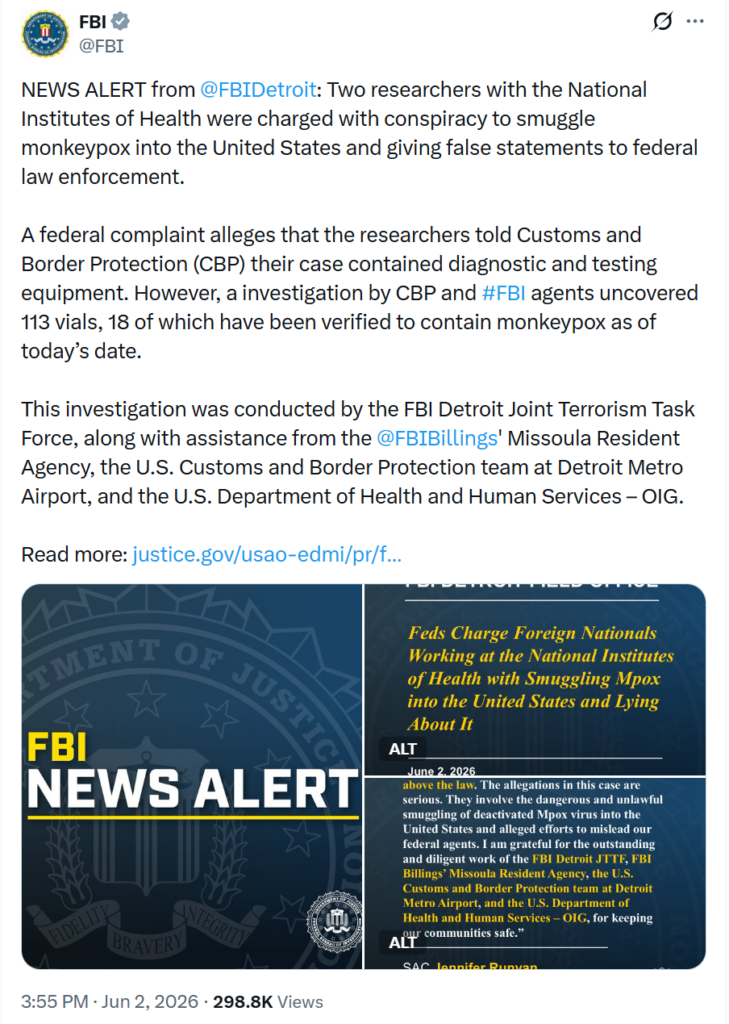
The Eastern District of Michigan Attorney’s Office confirmed the charges on Tuesday, noting that Claude Kwe and Vincent Munster both worked as researchers at the Rocky Mountain National Institute of Health (NIH) Laboratory.
Kwe is a citizen of Cameroon, and Munster is a citizen of the Netherlands. Both are charged with the plot to smuggle the viral disease into the nation and lying about it. The pair is accused of bringing 113 vials into the Detroit Metropolitan Airport on January 25 after traveling to Brazzaville in the Republic of Congo, where a monkeypox outbreak was active. They lied to Customs and Border Protection about the contents of their luggage upon their arrival in the U.S.

The FBI has currently tested 20 of the vials and found that 17 contained deactivated monkeypox, one contained chickenpox, and two contained human DNA.
“No researchers should believe their positions, credentials, or professional status place them above the law,” Jennifer Runyan, Special Agent in Charge of the FBI Detroit Field Office, stated. “The allegations in this case are serious. They involve the dangerous and unlawful smuggling of deactivated Mpox virus into the United States and alleged efforts to mislead our federal agents.”
The charges in the recent smuggling case are not uncommon. Just last summer, RSBN reported that two Chinese nationals were also charged by the same FBI office in Michigan with a conspiracy to smuggle a dangerous fungus into the U.S. to illegally conduct research on it at the University of Michigan.
Concerns regarding viral research have continued since the COVID-19 pandemic, which is suspected to have originated from a research lab in China.
This has brought harsh criticism of gain-of-function research, which sometimes involves manipulating viruses to test or even enhance their potency. Last year, President Donald Trump signed an Executive Order to stop American-led gain-of-function research due to its dangers.
