

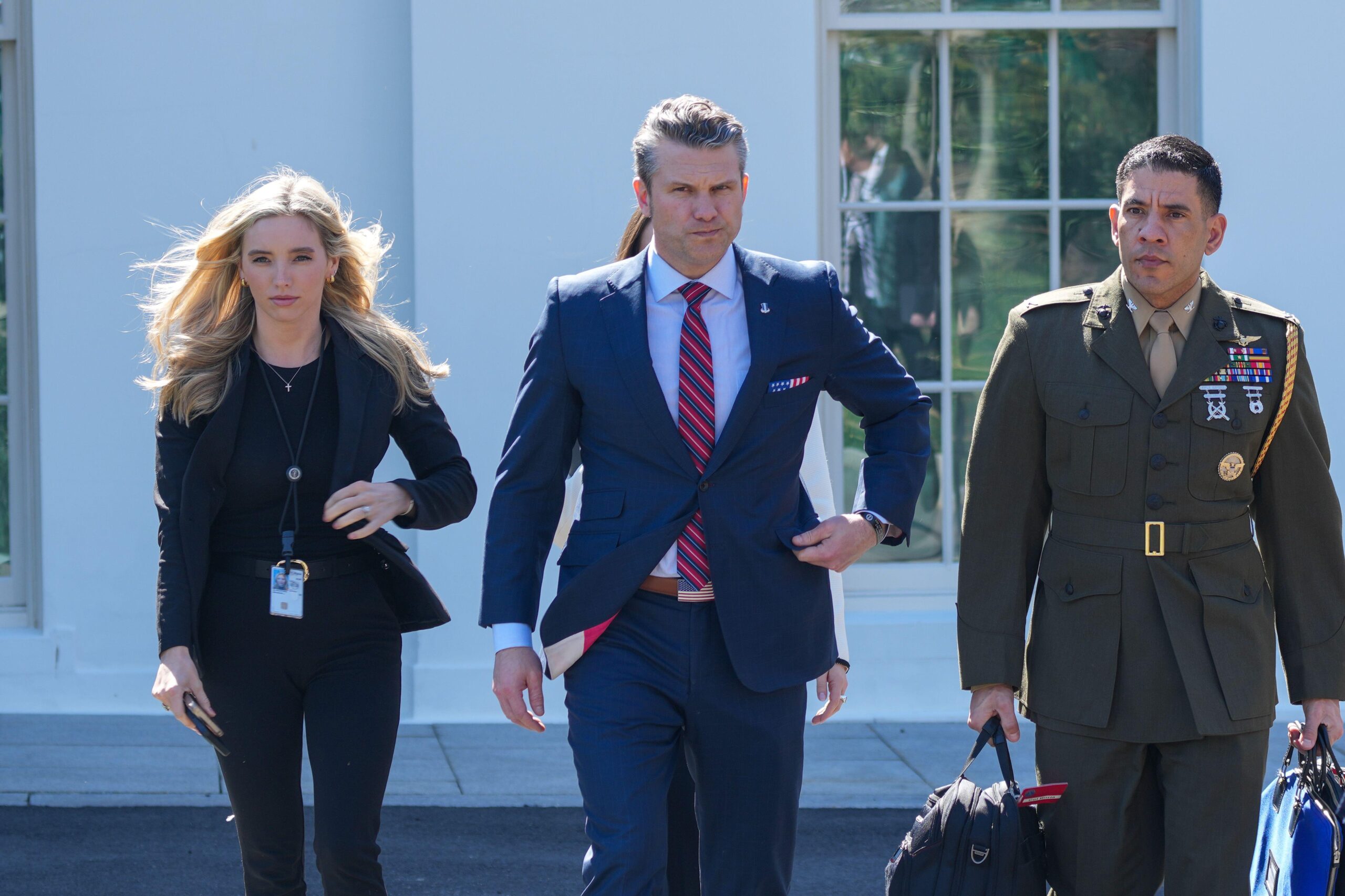
Photo: Alamy
Pentagon leadership on Tuesday answered key questions about Operation Epic Fury as the U.S. continues to hit Iran where it counts, amid what Secretary of War Pete Hegseth said would be the “most intense day of strikes inside Iran” to date.

Hegseth said the U.S. military was “winning decisively” against Iran, painting a picture of a Pentagon that is laser-focused on ultimate victory, and contrasting that against the “quagmires” of yesteryear, under the Bush and Obama administrations.
“Our generation of soldier will not let that happen again, and nor will this president, who very clearly ran against those kinds of never-ending, nebulously-scoped missions,” Hegseth said. “Those days are DEAD. Instead, we’re winning decisively with brutal efficiency, total air dominance, and an unbreakable will to accomplish the president’s objectives on our timeline. We stay locked on the target, because here at the Department of War, that’s our job.”

Amid many updates, including a slate of attacks that Hegseth said would be the most brutal so far against Iran, Chairman of the Joint Chiefs of Staff, Air Force General Dan “Razin’” Caine, said that Iranian missile attacks had decreased by 90 percent, and one-way drone attacks had dropped by 83 percent.
More than 5,000 targets have been hit so far, according to the information presented on Tuesday.
Reporters were also allowed to ask questions on Tuesday morning – and there were plenty.
Is there an update on the continued degradation of Iranian missile and nuclear capabilities?
Secretary Hegseth said that the numbers presented by Gen. Caine on Tuesday, purporting a 90 percent decrease in missile attacks and an 83 percent dip in one-way drone attacks, represent “a persistent low ability to respond, which is what we’re looking for.”
In other words, the overall average of the Iranians’ ability to respond militarily has consistently fallen.
Responding to reports of Iran’s potential next Supreme Leader
Reports surfaced this week that Iran’s next preferred Supreme Leader, Mojtaba Khamenei, was potentially wounded in air attacks. Secretary Hegseth said he could not comment on Khamenei’s condition at this time.
President Trump’s phone call with Russian President Vladimir Putin
Hegseth said the president’s call to Putin was, to his knowledge, “strong” and “reaffirming, hopefully, the opportunity for some peace in Russia-Ukraine, and also a recognition that as it pertains to this conflict, they should not be involved.”
Operation Epic Fury timeline and Iranian military adaptability
Secretary Hegseth would not confirm any potential timeline for ending this operation against Iran. “Where we are is in a very strong place, giving the President of the United States maximum options,” he said. “…Ultimately, the president gets to determine the end state of those objectives.”
He assured Americans that this operation was “not endless, this is not protracted, this is not mission creep.”
Hegseth said it was “not for me to posit whether it’s the beginning, the middle, or the end.”
As far as the Iranian fighters’ ability to adapt to U.S. and Israeli attacks, Gen. Caine said, “They’re fighting, and I respect that, but I don’t think they’re more formidable than what we thought.”
Was the U.S. involved in the massive air strikes on oil depots in Iran?
“Israel’s been a really strong partner in this effort,” Secretary Hegseth said. “Where they’ve had different objectives, they’ve pursued them. Ultimately, we’ve stayed focused on ours.”
However, he noted that those strikes “in that particular case, those weren’t our strikes… or wasn’t necessarily our objective.”
And, to address concerned Americans worried that Israel may be placing intense pressure on the U.S. in terms of this military conflict, he noted, “We’re not getting pulled in any direction. We’re leading, the president is leading. He’s determining where we want to go, what the outcome will be, what the end state will be, with a very keen eye. ”
The Strait of Hormuz, minimizing civilian casualties
The U.S. is considering its options when it comes to taking control, potentially, of the Strait of Hormuz, according to Gen. Caine. He offered little other details. And as Iran has targeted neighboring countries in surprising attacks amid the conflict, Hegseth said this was a sign that the Iranian regime was “flailing recklessly.”
Hegseth explained that Iran’s aggressive actions toward its neighbors only further alienated them from other countries.
And, on the issue of mitigating civilian casualties, Hegseth was firm: “No nation takes more precautions to ensure there’s never a targeting of civilians than the United States of America…no nation in the history of warfare has ever attempted in every way possible to avoid civilian casualties, and frankly, that’s a point that just isn’t appreciated enough.”
Will Operation Epic Fury conclude soon?
Again, the Pentagon offered no clear timeline for the conclusion of this mission, but Hegseth was clear that such an end will be to the benefit and betterment of the U.S.
“The aftermath is going to be in America’s interests, our interests,” he said. “We won’t live under a nuclear blackmail scenario of conventional missiles that can target our people…that’s what matters to President Trump, that’s what matters to the American people.”
