

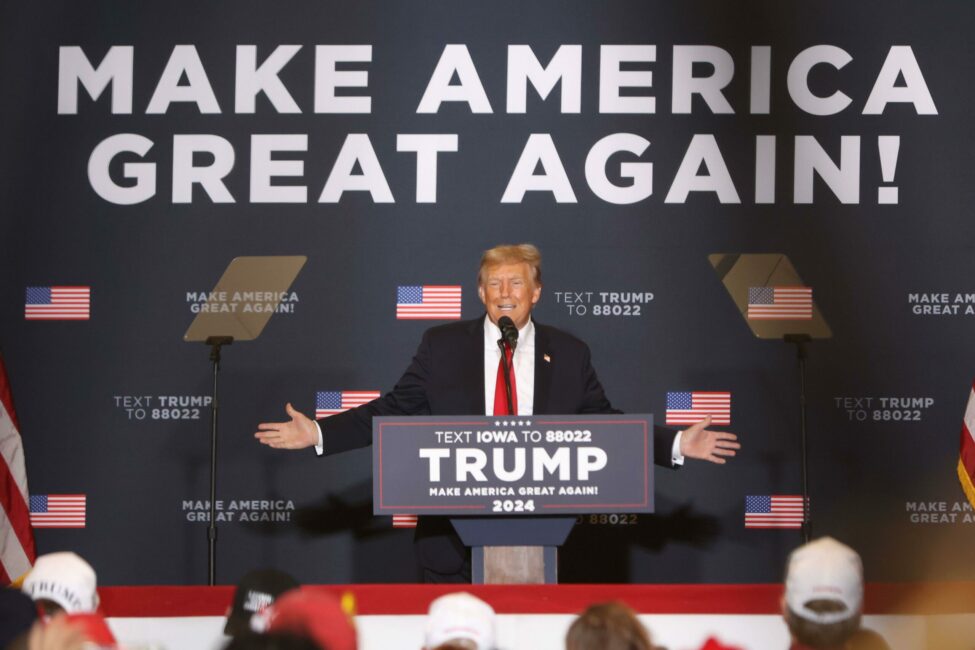
Op-ed by Alex Caldwell | Photo: Alamy
The Colorado Supreme Court marked a perilous moment in history with their ruling to disqualify President Donald Trump from appearing on the state’s ballot for next year’s presidential election late on Tuesday.

In a 4-3 decision, the Democrat-appointed court declared the 45th president violated Section 3 of the 14th Amendment, which bars those who have “engaged in insurrection or rebellion” against the United States from holding public office.
This controversial decision will likely be brought to the U.S. Supreme Court, as the Trump team has vowed to appeal their case. While no official court date has been scheduled, the high court’s ruling will set a historic precedent for elections to come and whether or not a state can simply remove any candidate from their ballot.

However, the question remains as to what implications the Colorado Supreme Court’s verdict will have not just on Trump, but on Democrats and Joe Biden.
Background Of The Case
Since the beginning of the 2024 campaign, Democrats have ensued countless legal gymnastics to stop President Trump from winning the presidency next fall—most recently in the Rocky Mountain State.
Citizens for Responsibility and Ethics in Washington (CREW), a left-wing litigation team that celebrates using “aggressive legal actions” against its opponents, along with two unaffiliated voters and four Colorado Republicans, filed a suit against Trump in September to disqualify him from appearing on the state’s primary ballot.
Citing Trump’s supposed violation of Section 3 of the 14th Amendment, the group stated he was ineligible to hold public office for “recruiting, inciting, and encouraging a violent mob that attacked the Capitol on January 6, 2021.”
The organization has lauded itself an an independent, “nonpartisan” entity fighting to weed out government corruption.
CREW’s boasting of its “nonpartisan” nature, however, has shown to be anything but. Its personal animosity towards the 45th president has been made apparent since he first entered the White House.
The leftist group has filed suits against the president as early as three days after his inauguration in January 2017. Moreover, the organization’s own website attempts to capitalize off of stopping Trump’s 2024 ballot access in Colorado, prompting site-goers to “make a donation to help defend this victory.”
Even the organization’s own president, Noah Bookbinder, has strong ties to Joe Biden, as he was appointed to Homeland Security Advisory Council by Biden’s Homeland Security Secretary Alejandro Mayorkas in March 2022.
In a post to X on Tuesday, Bookbinder called the Colorado Supreme Court’s motion to disqualify Trump from the state’s ballot “historic and justified,” and “necessary to protect the future of democracy in our country.”
Bookbinder’s leadership over a group attempting to disqualify a president from qualifying for office whilst simultaneously serving under their chief rival’s administration is certainly a question of ethics, and it could be interesting to see how the U.S. Supreme Court’s potential reaction to this circumstance may play out.
Trump Will Prevail Again: History Repeats Itself
As such with the legal gymnastics made thus far to block the reelection of Donald Trump, the Colorado Supreme Court’s ruling has the potential to completely backfire against Joe Biden and Democrats.
Trump has come out on top after each and every legal battle—including four criminal indictments and several court cases aimed to disqualify his candidacy in several other states—with his polling exploding upwards after each legal battle.
On March 31, the day of Trump’s first indictment, he led the 2024 GOP primary field with 45.9 percent, while Florida Gov. Ron DeSantis came in a near second at 30.1 percent, according to polling averages from Real Clear Politics.
Following a slew of legal maneuvers aimed at stopping his candidacy, Trump increased his polling to 64.8 percent, whilst DeSantis dropped down to 11.1 percent as of Dec. 20, according to polling averages.
Trump has also experienced the same polling trend nationally against Joe Biden. Per Real Clear Politics, Trump and Biden averaged at 43 percent support each the day of Trump’s first indictment.
Following three more indictments and various court cases challenging his candidacy, Trump has expanded his support to 47.1 percent to Biden’s 44.5 percent for the nationwide popular vote as of Dec. 20, Real Clear Politics averages reported.
Should these past trends come to fruition once more, Trump is set to skyrocket even more in the polls and in fundraising, further solidifying his status as the Republican frontrunner and potentially the 47th U.S. president.
Many Democrats were also reportedly upset with the ruling, according to a report from NBC News. According to a source allegedly familiar with White House and Biden campaign officials, Democrats worry the ruling will actually hurt their party rather than Trump and Republicans.
“They’re pissed,” the source reportedly told NBC News. This decision makes it look “like Colorado is attempting election interference through non-elected Democratic-appointed justices with funding from ‘shady left-wing donors.”
The source concluded, “We all hope Biden wakes up on Christmas morning to an A3 story in the Delaware News Journal saying that the Supreme Court ruled 9-0 in favor of Trump.”
What Comes Next
Though it is impossible to predict future rulings of the Supreme Court, it is likely safe to assume that the nation’s highest court will examine this case with the upmost scrutiny.
Trump has not been convicted of any crime dealing with inciting an insurrection, so it is very possible the Supreme Court could use this argument to overturn the ruling of Colorado.
A 6-3 conservative-leaning U.S. Supreme Court, political leanings might also influence their ruling. Additionally, although all seven of Colorado’s Supreme Court justices being appointed by Democrat governors, the 4-3 decision passed by just one vote in an already liberal court, an indication of the case being possibly overturned by a conservative federal court.
The Colorado Supreme Court currently issued a stay of the ruling from taking effect until Jan. 4, meaning that if the case is is sought by the U.S. Supreme Court before this date, Colorado would be required to keep Trump’s name on the ballot at least until the highest court makes their official ruling.
Per Axios, the Colorado case has been one of roughly thirty state’s cases challenging Trump’s ballot access. Five states have already dismissed this case, most recently in Minnesota and Michigan.
Several remaining pending cases reside in states like New York, Texas, Nevada, Wisconsin, and Virginia.
