

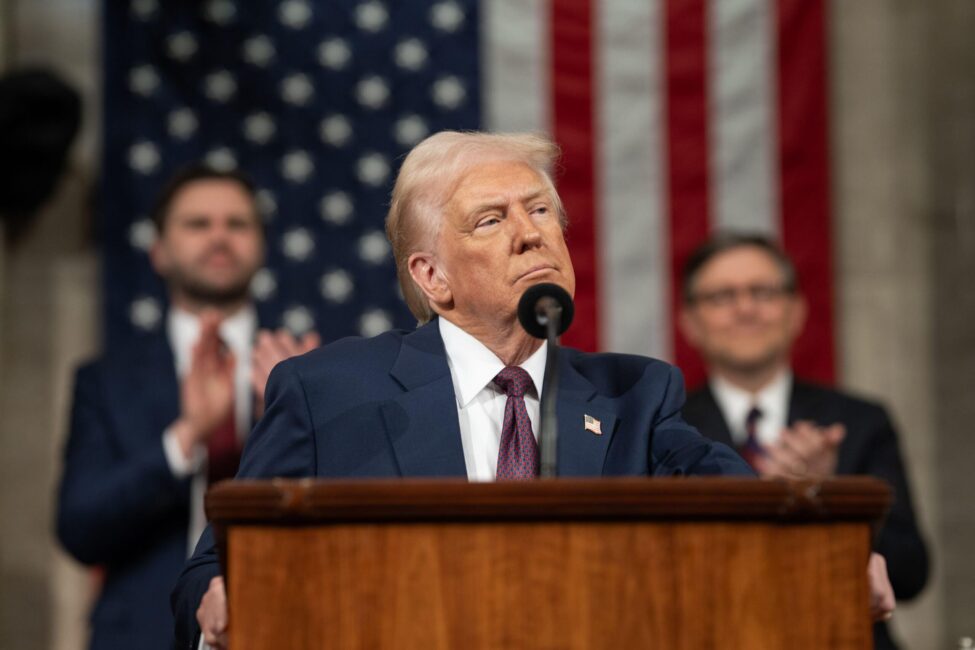
Photo: Alamy
President Donald Trump announced Wednesday morning that, amid the war in the Middle East, Iranian leadership has asked for a ceasefire. This comes just hours before the president is scheduled to deliver an address to the nation.

“Iran’s New Regime President, much less Radicalized and far more intelligent than his predecessors, has just asked the United States of America for a CEASEFIRE!” the president said on Truth Social.
He added, “We will consider when Hormuz Strait is open, free, and clear. Until then, we are blasting Iran into oblivion or, as they say, back to the Stone Ages!!!”

As reported by RSBN, President Trump on Tuesday said that U.S. military operations in Iran could wrap up within the next two or three weeks, highlighting the Strait of Hormuz as a sticking point, yet relegating its security to other countries.
“Look, the problem with the strait—a guy can take a mine, drop it in the water, and say, ‘Oh, it’s unsafe.’ It’s not like you’re taking out an army, or you’re taking out a country. That’s not for us, that’ll be for France, that’ll be for whoever is using the strait,” he remarked.
President Trump’s scheduled remarks on Wednesday night have drawn intense speculation in the press as the war enters its fifth week.
Could he be planning to declare swift victory in Iran, or will he announce further military operations in the region?
“The president, I’ve known him for 35 years – he doesn’t deliver bad news like this. So you can expect a positive speech…The president will put a positive face on the situation,” said political commentator Bill O’Reilly, during an interview on News Nation.
He added, “He’ll run down his greatest hits like he always does…and then he’ll pivot. I’m not sure what the Iranians have agreed to, but they’ve agreed to something. So, he’s not going to go on and say, ‘Hey, I don’t have anything, thanks for watching…’ He’s not going to do that. So, the Iranians agreed to something.”
O’Reilly’s observation also comes amid Israeli Prime Minister Benjamin Netanyahu’s recorded statement ahead of Easter, where he said that Iran no longer posed an existential threat to his nation.
“It is true, they still have residual capability to threaten us, but they can no longer threaten our existence, or launch the tens of thousands of ballistic missiles and rockets that were intended to destroy Israel’s cities,” he said.
Could this development, coupled with President Trump’s statement about Iran’s request for a ceasefire, be a sign of authentic de-escalation in the Middle East? Possibly, but nothing is guaranteed.
The conflict with Iran has had widespread effects, particularly as the Strait of Hormuz has come to a halt, affecting gas and energy prices. The European Union estimates that gas prices have risen by 70 percent and oil prices by 50 percent since the beginning of the war – an energy shock with global implications.
For example, Australian Prime Minister Anthony Albanese delivered a national address this week about the global effects of Operation Epic Fury. “The reality is, the economic shocks caused by this war will be with us for months,” PM Albanese stated.
UK Prime Minister Keir Starmer will also address his countrymen on Wednesday.
