

Photo: Alamy
It’s no secret that cryptocurrency has gained traction over the past few years, demonstrating the growing power of the digital financial market amid a shaky economic landscape.

Cryptocurrencies like Bitcoin are not inherently linked to any singular currency system and, as such, are often referred to as “trustless” systems. However, Stanford Law Professor Joseph A. Grundfest has argued that the “trustless” label may not be accurate.
Via information he provided to Stanford Online:

“They are still reliant on the underlying infrastructure powering cryptocurrencies like Bitcoin, much of which is located in China. The Chinese government could theoretically make changes to cryptocurrencies at a fundamental level by imposing its will on the data miners who keep them running.”
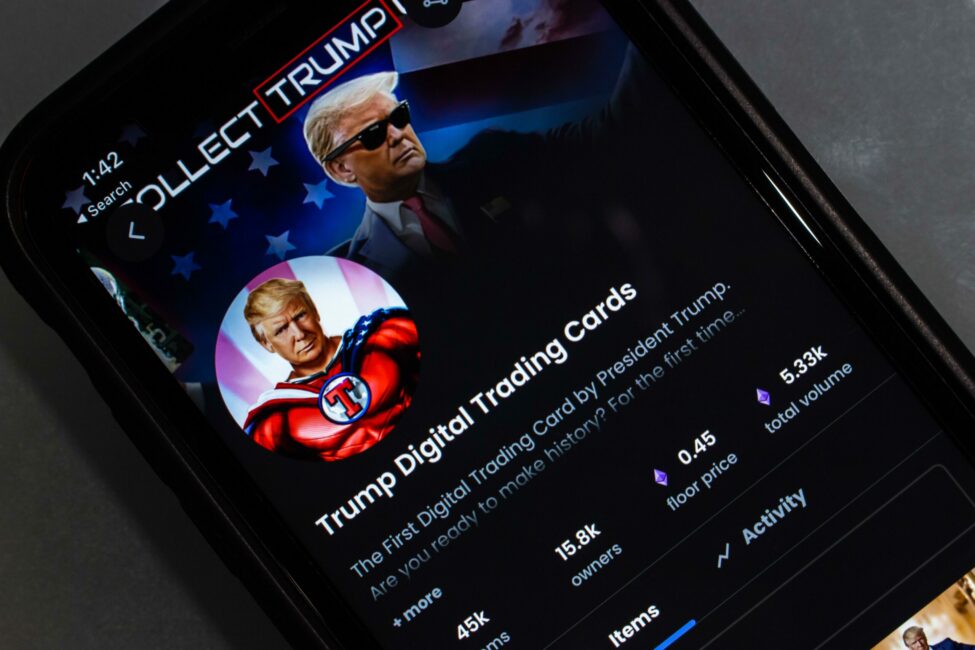
Cryptocurrencies, NFTs, and collectible digital coins have become popular in the rapidly evolving digital asset market. In fact, even President Donald Trump has dabbled in the digital market—selling collectible digital trading cards, for example, and offering a popular Trump MAGA Coin, or a “meme coin.”
According to Benzinga, the digital token has surged to a near $500 million market cap amid President Trump’s hot streak of GOP primary victories in 2024, and he is earning royalties on those tokens, which have been worth as much as $6.7 million each.
Clearly, cryptocurrencies are something to pay attention to, but the real question that seems to loom in the conversation about this new digital frontier is whether it has the potential to weaken the already-sinking U.S. dollar further.
President Trump recently weighed in on this issue during an interview on CNBC’s “Squawk Box.” He explained, “If you think of it, it’s an additional form of currency, and I used to say, ‘I want one currency, I want the dollar, I don’t want people leaving the dollar.’ I feel that way, but I will tell you, it has taken on a life.”
The president mentioned his recent “sneaker” venture from February, where he released 1,000 collectible “Never Surrender” gold sneakers for diehard supporters. He said that he allowed people to purchase those sneakers with cryptocurrencies.
“So many of them were paid for with the new currency,” he said, referring to crypto.
However, while the president acknowledged crypto’s popularity, he tempered his comments with insight into what his approach to the digital craze would be as a prospective sitting president again in 2025.
He added, “You know, I’m very much a traditionalist. I like staying with the dollar…I hate when countries go off the dollar. I would not allow countries to go off the dollar [as president] because when we lose that standard, that will be like losing a revolutionary war. That will be a hit to our country just like losing a war.”
Previously, Trump has also promised to block the creation of a Central Bank Digital Currency. “Such a currency would give a federal government – our federal government – the absolute control over your money…this would be a dangerous threat to freedom and I will stop it from coming to America,” he explained in January.
