


Photo: Alamy
Despite facing a challenging political environment, House Republicans could be better positioned than expected heading into the 2026 midterm elections.

House Republicans’ narrow majority is expected to narrow further, although early projections suggest the party may avoid the kind of sweeping defeat that has historically defined midterm elections.
Democrats have recently begun adopting various redistricting efforts—wiping out Republican-held seats in conservative locations to boost their numbers. In California, a successful ballot initiative redrew five Republican seats to greatly favor Democrats. Virginia voters narrowly adopted a similar resolution, eliminating four of the state’s five Republican seats to benefit Democrats.

Republicans, however, are also positioned to gain seats through redistricting in other parts of the country. In Missouri, Texas, North Carolina, and Florida, GOP-favored maps could yield a pickup of several seats. Early estimates suggest that Republicans could gain one seat in Missouri, at least three in Texas, one in North Carolina, and four in Florida.
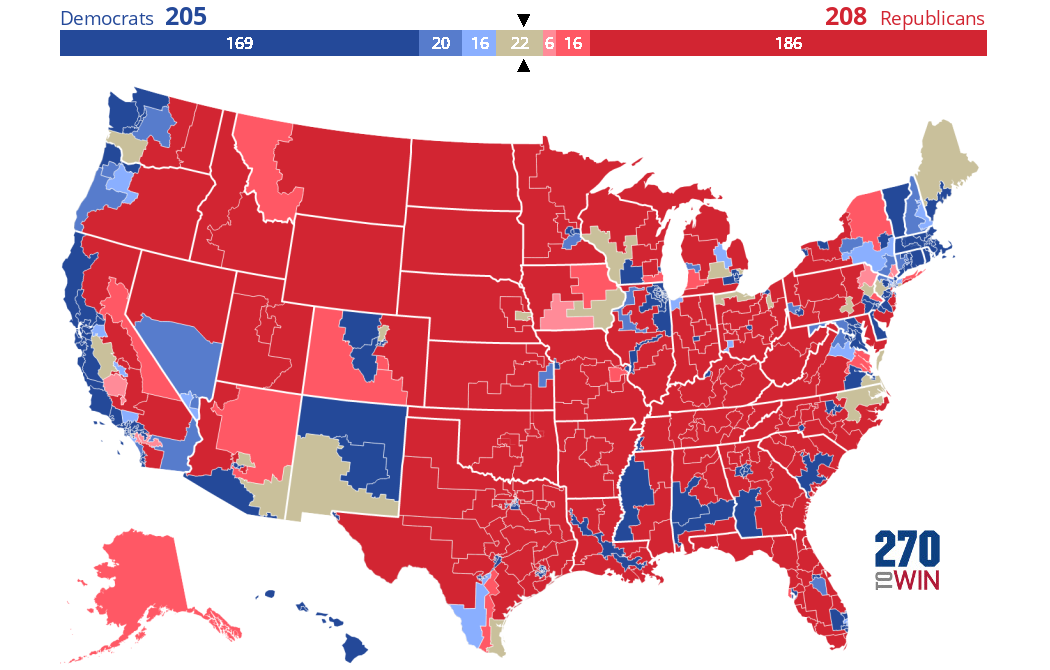
Taken together, these shifts show how redistricting may blunt the overall implications of national political trends. Even in a scenario where Republicans lose all competitive swing districts—which is unlikely—indicate that the party would retain roughly 205 House seats—a relatively strong number compared to previous midterm loses.
For the past 50 years, the president’s party, with the single exception of George W. Bush, has always lost House seats in midterm elections. With this in mind, a closer-than-expected Republican loss, or a closely divided House, would represent a departure from this trend.
Republican officials across southern states could also eliminate Democrat-held House seats amid the Supreme Court’s abolition of Section 2 of the Voting Rights Act.
Louisiana’s GOP Gov. Jeff Landry previously suspended his state’s House primaries until at least July in reaction to the high court’s ruling—a decision of which could add one or two additional Republican congressional seats, RSBN reported.
Tennessee lawmakers are also weighing proposals to redraw the state’s lone Democrat-held congressional district. Other southern states, such as Alabama, Mississippi and South Carolina, may also draw out their Democratic seats, which total four more seats.
Beyond map changes, individual races will shape the balance of power. Republicans are already targeting swing seats, including Maine’s 2nd Congressional District. With Democrat Rep. Jared Golden’s retirement, Republicans view Maine’s former Gov. Paul LePage as a formidable candidate in a district President Trump carried by nearly 10 points in 2024.
Even so, House control will likely come down to a narrow set of competitive districts. Races in swing-states, including Pennsylvania, Arizona, Michigan and New York, are expected to play a major role in determining the balance of power.
